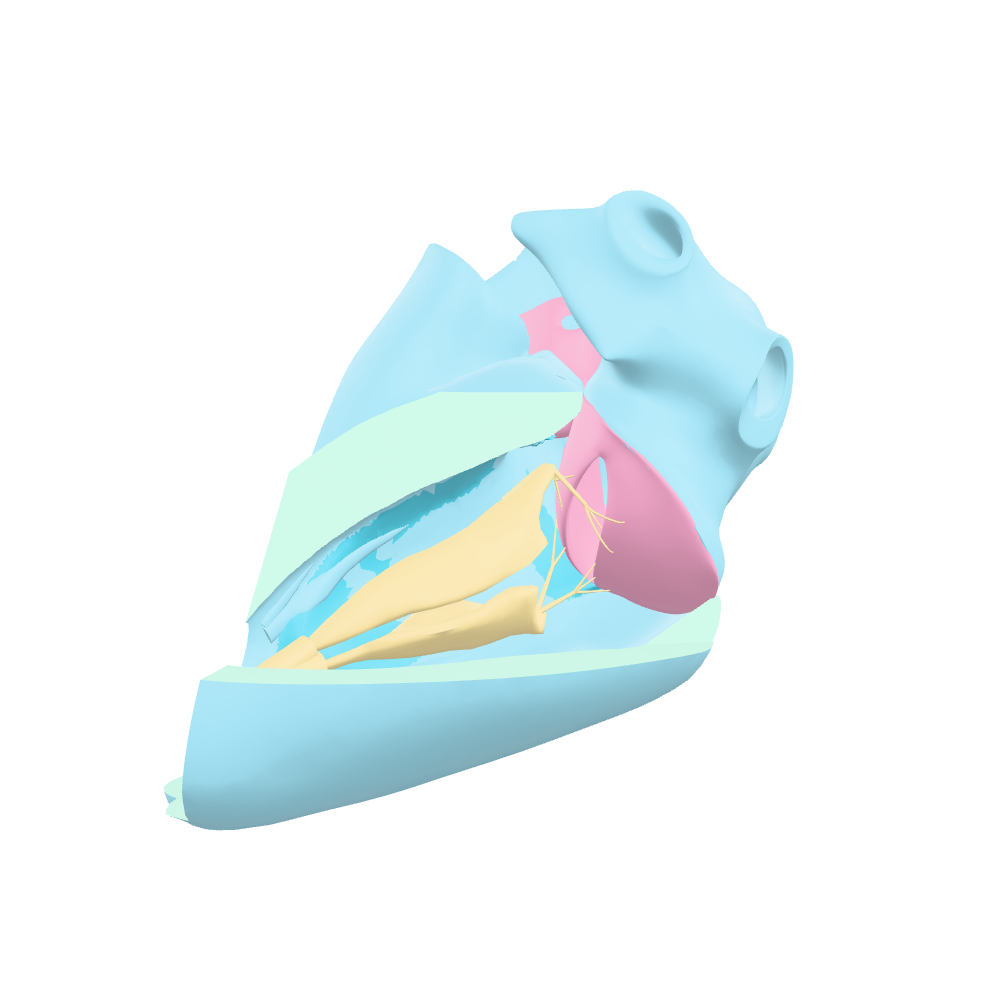

An end-to-end clinical AI lab for multimodal medicine.

Project Quintessence builds and trains medical AI models, validates them against clinical evidence, and integrates them into workflows where performance, uncertainty, and usability can be tested in practice.

Lab model

From fragments to validation, one continuous evidence surface.

01Mission

Build medical AI that can be tested, questioned, and improved.

Our mission is to develop multimodal AI systems for medicine that remain clinically interpretable, evidence-aware, and honest about uncertainty. The goal is not only model performance, but model behavior that can survive expert review.

Details

Focus

multimodal medicine, clinical reasoning, validation-stage AI

Standard

claims must match evidence

Outcome

research artifacts clinicians and institutions can examine

02What we build

Models, agents, benchmarks, and workflow prototypes.

We work across clinical language models, agentic systems, forecasting, medical imaging, and physiologic world models. Each project is shaped around a clinical question, a technical method, and a validation path.

Details

Tracks

language, agents, forecasting, imaging, physiology

Artifacts

models, benchmarks, studies, prototypes

Outcome

a connected research program, not isolated demos

03Where we are

Validation-stage research across active clinical AI programs.

Project Quintessence is currently research-first: some studies are completed, others are ongoing or in validation planning. The work is positioned before deployment language, where methods, evidence, uncertainty, and workflow fit can still be challenged.

Details

Status

completed, ongoing, validation planning

Posture

research before deployment claims

Outcome

a clearer boundary between promise and clinical readiness

04How we work

Start with the clinical question, then build the evidence path.

We scope each collaboration around the problem, the available data, the clinical workflow, and the evidence needed to evaluate the model. Development, validation, and usability are designed together rather than added after the fact.

Details

Process

question, data, model, evaluation, workflow

Partners

hospitals, labs, clinicians, engineers, academic groups

Outcome

protocols, models, studies, and reproducible research outputs

Evidence strata

Five research paths, one connected validation surface.

Each area contributes methods, outputs, active studies, and validation principles to the same evidence-grounded research system.

Five Research Tracks. One Standard of Evidence.

We focus our clinical AI research across five core disciplines—from medical language models to physiologic simulation. Each track is structured around a specific clinical question, a reproducible training methodology, and open-source evaluation tools so partners can inspect model behavior before deployment.

Language Models & Clinical NLP

Clinical language models and NLP systems from data construction to expert-led validation.

Methods, outputs & studies

Methods

  • data construction
  • SFT
  • RL / preference optimization
  • encoder models
  • retrieval grounding
  • expert evaluation

Outputs

  • post-trained LLMs
  • BERT-based clinical classifiers
  • SFT and preference datasets
  • expert-validated benchmarks
  • clinical reasoning evaluations
  • synthetic data generation

Validation principle

We evaluate models by clinical correctness, evidence traceability, calibration, robustness, and expert adjudication. Fluency is not treated as evidence of competence.

Projects

NephroGPT: A Tool-Augmented Large Language Model for Nephrology Training and Continuing Education

Agentic AI Systems

Specialist agent workflows with auditable tool use and evidence-grounded decision traces.

Methods, outputs & studies

Methods

  • agent orchestration
  • tool-use policy learning
  • workflow state modelling
  • retrieval / EHR grounding
  • multimodal context fusion
  • agent trajectory evaluation

Outputs

  • specialist agent workflows
  • auditable tool-execution traces
  • workflow simulation benchmarks
  • clinical task routers
  • safety and failure analyses

Validation principle

Agentic performance is accepted only when plans, tool calls, evidence inputs, intermediate states, and failure boundaries are inspectable by clinical reviewers.

Projects

An Evidence-Grounded Multimodal Agentic AI Co-Pilot for Cardiologists

Predictive Modelling & Forecasting

Risk estimation, temporal modelling, intervention analysis, and reproducible outcome validation.

Methods, outputs & studies

Methods

  • risk prediction modelling
  • time-series forecasting
  • longitudinal representation learning
  • survival / event modelling
  • causal intervention analysis
  • calibration and drift monitoring

Outputs

  • validated risk models
  • forecasting pipelines
  • intervention impact estimates
  • temporal surveillance analyses
  • reproducible prediction benchmarks

Validation principle

Prediction and forecasting models are evaluated by temporal holdout performance, calibration, drift sensitivity, intervention timing, and reproducibility across cohorts—not one-off fit metrics.

Projects

The Impact of COVID-19 Non-Pharmaceutical Interventions on Notifiable Infectious Diseases in Poland

Computer Vision & Medical Imaging

Medical imaging models spanning chest radiography, report-derived supervision, and multimodal post-training.

Methods, outputs & studies

Methods

  • image-text alignment
  • report-derived supervision
  • multimodal post-training
  • foundation CXR modelling
  • biomarker validation
  • radiology benchmark curation

Outputs

  • CXR foundation model variants
  • automated report labelers
  • image-report datasets
  • imaging-derived biomarkers
  • clinical vision benchmarks

Validation principle

Medical vision models are evaluated against image findings, report agreement, calibration, subgroup robustness, and downstream clinical meaning; benchmark scores are not treated as sufficient validation.

Projects

Benchmarking Large Language Models for Automated CheXpert-Style Labeling of Chest X-Ray Reports

ChexQwen: A Post-Trained Multimodal LLM as a Foundation CXR Model

Physiologic World Models

Learned models of patient-state dynamics that forecast trajectories and simulate counterfactual futures.

Methods, outputs & studies

Methods

  • latent state-space modelling
  • temporal representation learning
  • cross-modal generation
  • counterfactual simulation
  • uncertainty quantification
  • trajectory validation

Outputs

  • patient-state representations
  • physiologic trajectory simulators
  • ECG-to-echo generation systems
  • multimodal surrogate models
  • uncertainty-calibrated synthetic cohorts

Validation principle

A physiologic world model is valid only if its learned state dynamics preserve temporal coherence, cross-modal consistency, intervention sensitivity, and calibrated uncertainty against held-out clinical trajectories.

Projects

EchoWorld: Generative Echocardiography from ECG and Clinical Context